
Drop your track
WAV, MP3, AIFF or FLAC. Give it a name, say it’s yours, done. No pitch to write, no bio needed.
Tracks matched to labels, on the sound alone.
How it works
WAV, MP3, AIFF or FLAC. Give it a name, say it’s yours, done. No pitch to write, no bio needed.
Foundry compares your track to the actual releases of every label on the platform and ranks the closest ones. It only listens to the audio. Your name and your numbers never enter into it.
Tick a box and your track lands in the label’s own inbox here, playable, with its score next to it. Already know who you want? Skip the ranking and send it straight to any label or artist taking demos.
Where it lands
Labels on nine71 read their demos in this inbox. When you hit send, this is where your track shows up — ranked against everything else they got, ready to play.
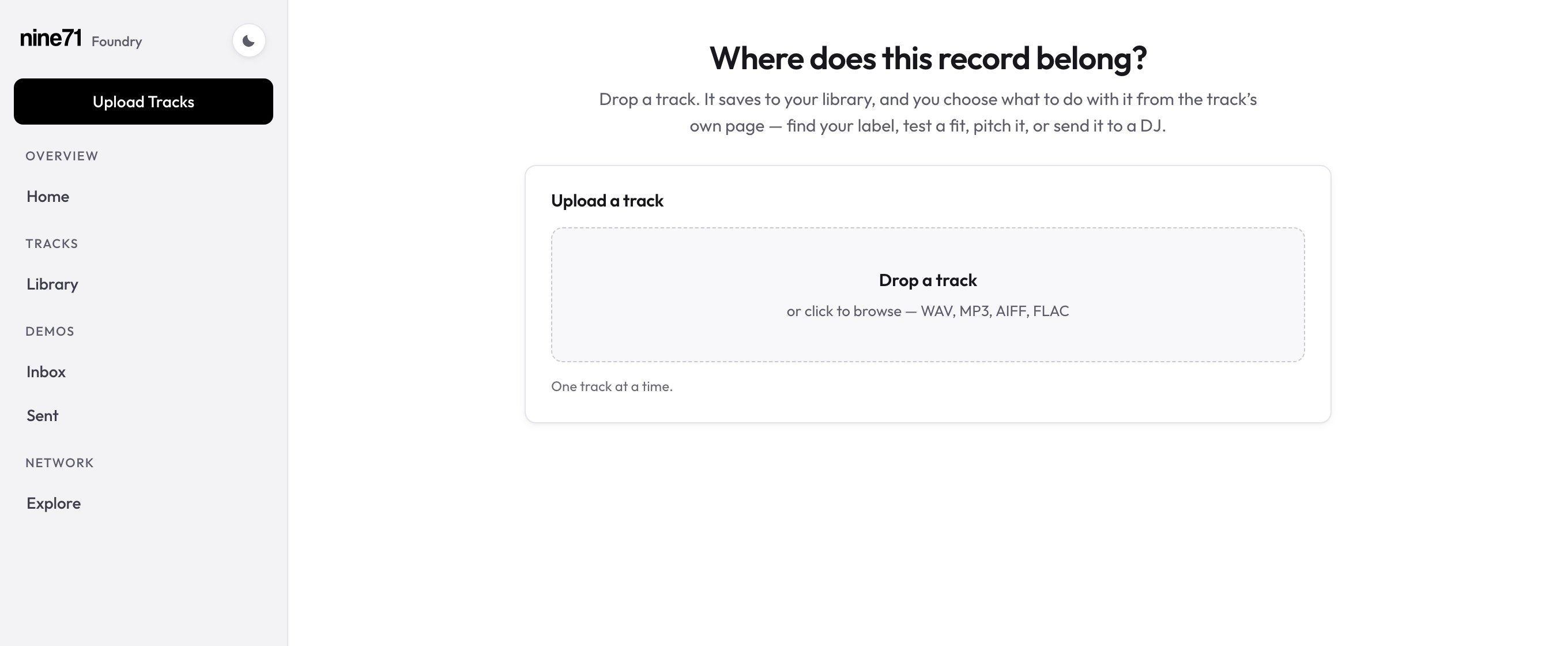
The Foundry workspace — drag a file in, name it, test it. This screen is the real thing.
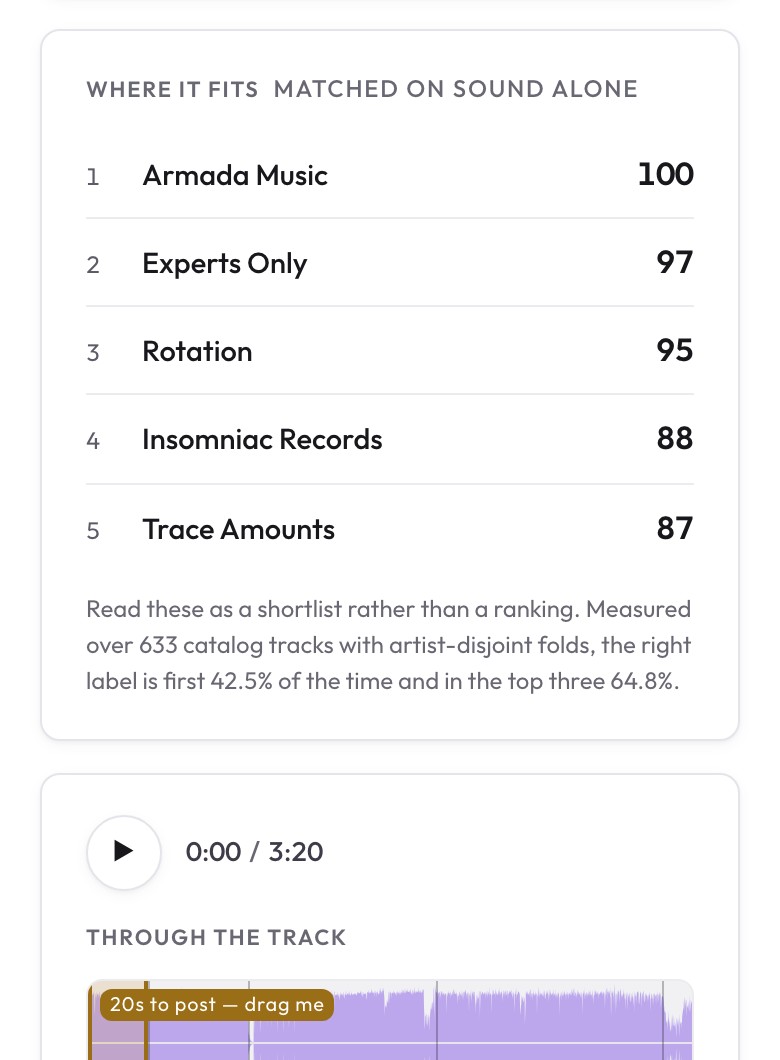
The shortlist on your phone, with the measurement behind it and one tap to send while the idea is still warm. A real result for a real upload.
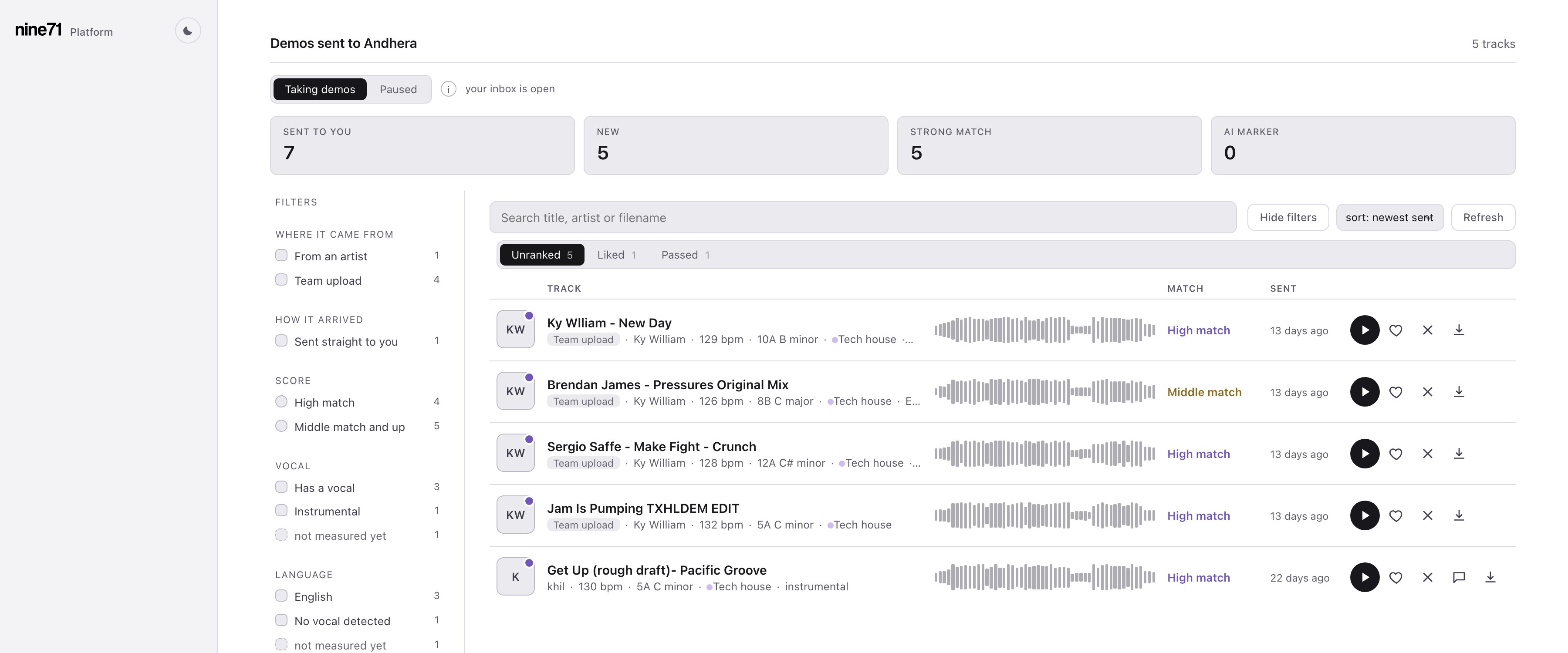
Your track arrives in the label’s own inbox, ranked against everything else they got, playable on the spot. Illustrative data.
Pricing · for artists
Score a track against every catalogue on Foundry as often as you like, on every tier including the free one. What a tier meters is how many of those tracks you then send out — because a send spends somebody else’s attention, and that is the part worth rationing.
Score it against every catalogue on Foundry, as often as you like, on every tier. It costs us a second of compute we were going to spend anyway, so capping it would make the product worse for no saving.
The one number that changes between the three. A send spends somebody else’s attention rather than our compute, and that is the scarce thing in this market — so it is the only thing worth rationing.
An account, and nothing else. Where everyone starts.
Free, and staying free.
You finish tracks on a schedule and send most months.
or $90 a year — two months free
You are shipping constantly and the send cap is in your way.
or $190 a year — two months free
A label’s inbox is ranked by how well a track fits that label’s own catalogue, and nothing on this page changes that ranking. A paid tier buys your own throughput — how many tracks you can send — and buys nothing on the receiving side. It does not raise your score, it does not reorder anybody’s inbox, and it will never put your track in front of a label it did not match. If money could buy placement, the ranking would be worthless to the labels who rely on it, and then it would be worthless to you.
Pricing · for labels
A label pays for the inboxes it runs, the catalogue it scores against, and the volume of demos it takes — never for the size of its A&R team. Every tier keeps your handle, your page and your demo address.
One label, one catalogue. What every label on Foundry has right now.
Free, and staying free.
One label with a real back catalogue and a real A&R team.
or $490 a year — two months free
A group running several imprints, each with its own sound and inbox.
or $1,490 a year — two months free
More than five imprints, a distributor, or a group whose finance team pays annually against a purchase order. Unlimited workspaces, unlimited team members, catalogue sizes and demo volumes by agreement. We quote it, you get an invoice on thirty-day terms with your PO number on it, and nobody types a card into a web form.
What you get
Not “here are 400 labels in your genre”. The handful whose sound your track actually sits inside, in order.
Wondering about a specific label? Score your track against just their catalog before you send anything.
Some artists take demos directly. They show up next to the labels, and sending works the same way.
Nothing is public. Only a label or artist you choose to send to can hear your track. Nothing is ever sent unless you tick the box.
My tracks holds everything you’ve tested — playable, with every score it got. Re-test a new version any time.
An account is all it takes, and scoring a track against every catalogue is unlimited on every tier. Sending is what carries a monthly number — five a month on the free tier.
Questions
The account is free and testing a track against every catalogue is free and unlimited, on every tier, forever. What a paid tier buys is more sends: the free tier sends five tracks a month, and that is the only limit on it. Nothing is charged today at all — see pricing.
Foundry listens to your audio and compares it to the music each label has actually put out. It is not matching genre tags or keywords, and it never reads your name, your bio or your follower counts. The track is the whole application.
You, and any label or artist you tick “send” for. That’s it. Your tracks are never public, never searchable, and never shown to anyone you didn’t send them to.
Labels on nine71 run their demo inbox here — it’s the same product, from the other side. When you send a track it appears in that inbox with its score, and they can play it on the spot.
WAV, MP3, AIFF, FLAC and most other audio formats. One track at a time.
Use “Send it straight”: pick the label or artist and send, no scoring involved. Your track, their inbox, done.
No. A low score means your track sounds far from that label’s releases, nothing more. Plenty of great records don’t fit a given catalog — that’s exactly what the ranking is for: finding the ones they do fit.
Organizations work in the nine71 platform — labels, agencies and management companies alike — and it takes the same nine71 account this page does. Make one, pick “I’m an organization” at the first screen, and your workspace opens there under the same sign-in; write to [email protected] if you would rather we set it up. If you’re an artist who wants to take demos, request an inbox of your own from your profile.